Multi-Diet Air Fryers: Cross-Contamination Tested
By Daniel Okafor • 4th Apr
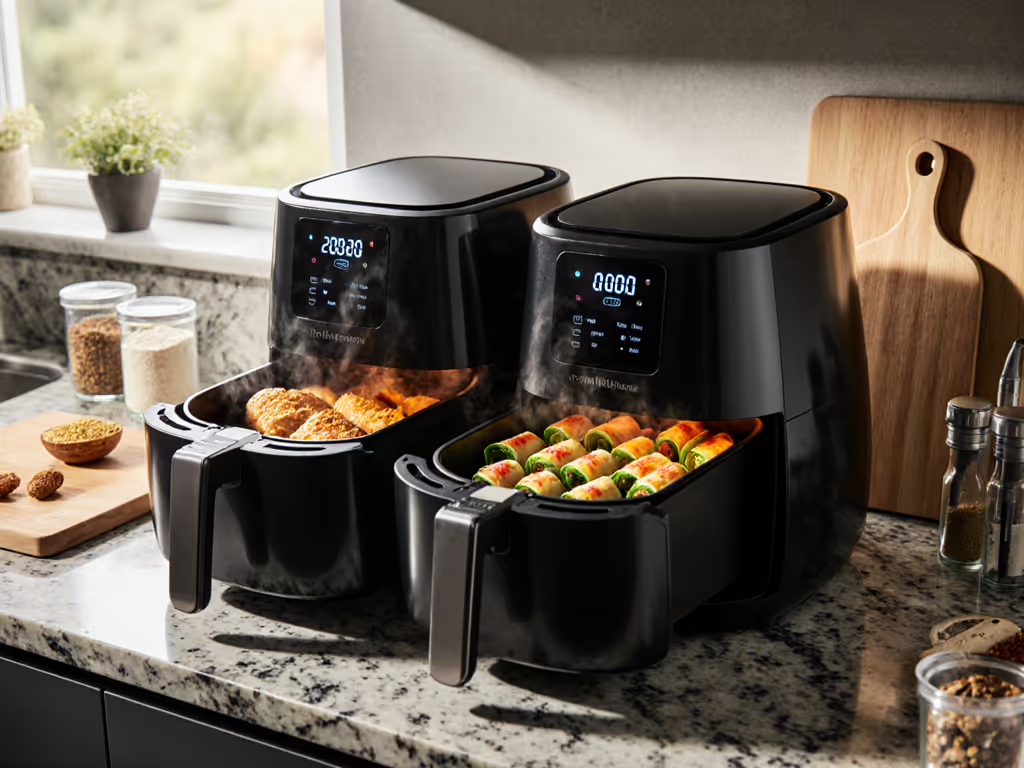
Cooking for multi-diet needs with an air fryer (whether managing multiple food allergies, religious practices, or competing preferences) stops being improvised once your equipment prevents mixing of allergens and flavors. This FAQ explores how dual-zone and single-basket air fryers handle cross-contamination prevention and testing, and which setups deliver allergy-safe cooking performance for mixed-diet families. For model-specific recommendations focused on allergy safety, see our best air fryers for food allergies.
I learned this watching my neighbor scale from cooking for himself to feeding a family where one child needed gluten-free meals, his partner avoided peanut oil residue, and his eldest preferred high-protein prep. His old single-basket air fryer meant sequential batches, shared cooking surfaces, and constant anxiety about trace allergen transfer. Once we mapped which multi-diet family air fryer models offered true isolation versus clever marketing, his weeknight workflow shifted from chaos to repeatable. That is when I realized: cross-contamination control is not a luxury feature, it is the foundation of simultaneous dietary needs air fryer success.
Does a Dual-Zone Air Fryer Prevent Cross-Contamination?
The Short Answer
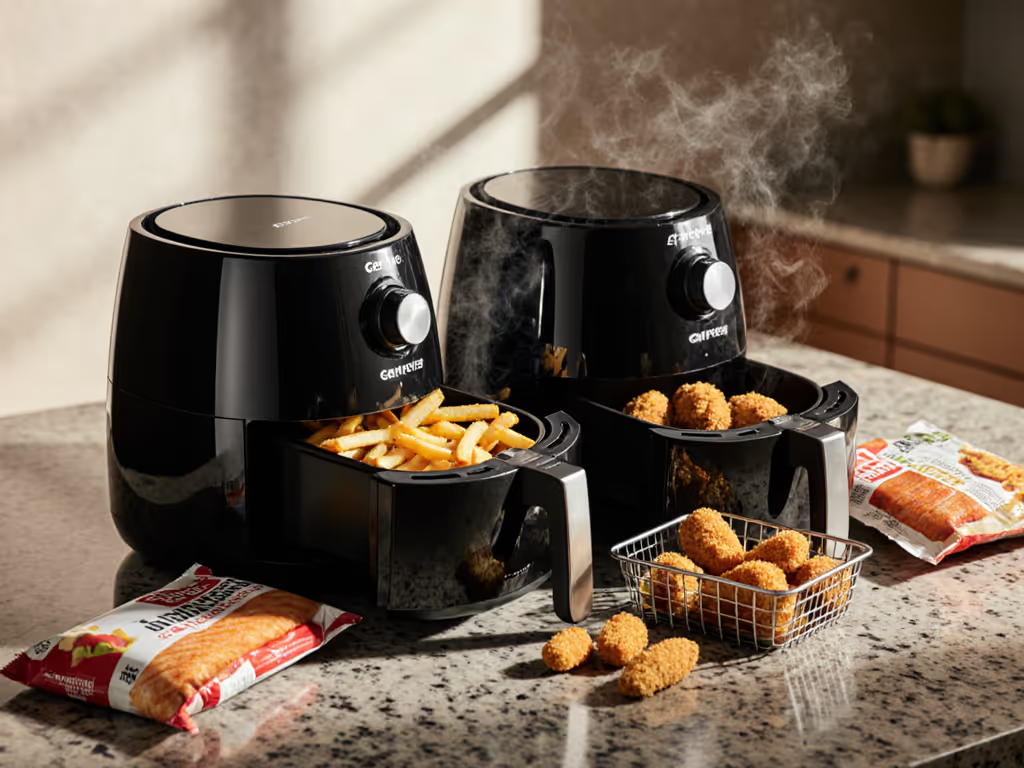
True isolation requires independent baskets with separate heating elements, sealed compartments, and different grease collection zones. Advertised "dual-zone" technology does not guarantee this. Some models share a single heating chamber with a divider, perfectly fine for cooking chicken and broccoli together, but problematic if you are preventing peanut oil residue from touching gluten-free items.
What Independent Baskets Actually Isolate
Models like the Ninja Foodi 6-in-1 with DualZone Technology feature two fully independent XL baskets. Each basket operates on its own timer and temperature setting, meaning:
- Separate air circulation paths: One basket's hot air does not mix with or travel to the other
- Distinct grease collection: Drippings do not pool or cross between compartments
- Sealed basket frames: Crumbs and spatter stay within their zone
- Isolated internal surfaces: No shared racks or screens where allergen transfer could occur
The Duronic Dual Air Fryer AF34 similarly provides each 5-liter drawer with its own cooking chamber. Conversely, single-large-basket models with an internal divider (sometimes marketed as "dual-zone") share the same heating envelope and grease management system, making them unsuitable for strict allergen isolation.
The Hidden Risk: Shared Grease Management
Even independent baskets can fail cross-contamination prevention if:
- Grease drips onto a shared lower tray before reaching separate collection zones
- Condensation or steam from one basket travels to the other through shared ventilation
- Crumbs fall through basket gaps during removal
- The unit lacks a removable, cleanable divider between zones
Critical check: Look for models where each basket has its own drip tray or where the grease path is completely sealed until collection. Ask manufacturers directly: "Are heating elements, grease channels, and air paths completely separate between zones?" Market-speak is not an answer. For step-by-step deep-clean methods that prevent hidden residue and crumb buildup, see our air fryer deep clean guide.
What Testing Reveals About Real-World Isolation
Industry-Standard Cross-Contamination Tests
Accredited testing labs simulate allergen transfer by:
- Cooking a high-allergen protein (e.g., peanuts, shellfish) in one basket at full capacity with visible oil release
- Immediately cooking a gluten-free or nut-free item in the other basket at standard settings
- Collecting and analyzing grease, steam, and air samples from the second basket
- Running amino acid or protein chain tests to detect trace allergen molecules
Those tests are not routine for consumer air fryers; they are voluntary and expensive. Most brands do not publish results. This is where you move from manufacturer claims to your own baseline.
DIY Baseline Testing for Your Home
Before relying on a dual-basket model for strict allergen prevention, establish your own protocol:
- Clean both baskets and the entire interior with hot soapy water and air-dry completely
- Cook an oily, visible-residue item in one basket: bacon, salmon skin-side up, or peanuts. Cook at 380°F for 12-15 minutes. Allow grease to accumulate visibly
- Immediately cook a neutral test item in the other basket: plain white rice or unseasoned potato cubes at 350°F for 8 minutes
- Inspect the second basket's interior surfaces with a bright light. Look for oil sheen, droplets, or residue on the basket walls, handle, or bottom
- Check the separate grease collection zone for any cross-migration of drippings
- Smell both items afterward cross-contamination often registers as aroma transfer before visible residue
If you see sheen, droplets, or detect smell transfer, that unit is unsuitable for strict allergen isolation. If it passes this baseline, you have calibrated realistic confidence in that model's isolation for your household.
Can You Cook Separate Diets Simultaneously Without Contamination?
Yes, With Design and Protocol
A multi-diet family air fryer with verified independent baskets allows true simultaneous cooking when you add one layer: systematic workflow. For a complete framework on planning mixed-diet air fryer meals, see our tested workflow for different dietary combinations.
The Three-Step Isolation Protocol:
Step 1: Pre-session prep (5 minutes before cooking)
- Designate one basket as "Basket A" (for allergen-free items) and one as "Basket B" (for items containing common allergens)
- Assign kitchen tools: separate cutting boards, utensils, and tongs for each basket
- Clean and dry Basket A's interior thoroughly; wipe with a paper towel to remove dust
- Place a fresh, single-use parchment liner in Basket A if the fryer's interior is non-coated or shows prior residue
Step 2: Load and execute
- Load Basket A first with allergen-free items; start the timer
- Load Basket B immediately after with any items; start its separate timer
- Use Match Cook (copies one basket's settings to the other for full capacity) only if both foods tolerate identical time and temperature. Use Smart Finish (syncs completion time) if foods need different settings but should finish together
- Do not pause or open Basket A mid-cook to check on Basket B (vapor and heat escape can cause cross-circulation)
Step 3: Post-session cleanup
- Empty Basket A first; place items on a clean plate
- Empty Basket B into a separate area
- Wipe down Basket A's interior with a damp cloth; repeat if visible residue remains
- Do not stack used baskets; allow each to air-dry separately
This workflow removes guesswork and scales to any multi-dietary combination: gluten-free + regular pasta, peanut-free + peanut sauce sides, low-oil + high-fat items.
Which Air Fryer Models Offer the Best Isolation Setup?
Verified Independent-Basket Models
Ninja Foodi 6-in-1 Smart 10-qt. with DualZone Technology: Two XL independent baskets, separate temperature and timer controls, Smart Finish for aligned completion, IQ Boost for optimized power distribution across zones. Ideal for: families with 3-5 members or batch prep workflows. Real-world capacity: ~4 lbs protein + sides per basket simultaneously.
Duronic Dual Air Fryer AF34: Each drawer holds 5L capacity with independent controls. Sync Cook and Sync Finish functions allow different foods to cook simultaneously or at the same pace. Advanced hot air circulation prevents cross-air mixing. Ideal for: couples, small families, and those with limited counter space. Real-world capacity: ~2-2.5 lbs per drawer.
Single-Large-Basket Models (Chefman 10-Quart Multifunctional, Cosori 9-in-1 TurboBlaze): These offer multiple cooking functions (air fry, bake, roast, dehydrate) and work well for single-diet households or sequential batch cooking. They do not isolate simultaneous multi-diet meals. Use for: individuals, couples, or families where all meals can share cooking surfaces. Their advantage: one shared interior is simpler to clean and often more durable.
The Trade-Off: Capacity vs. Isolation
Dual-basket models sacrifice per-meal capacity (two smaller zones) for isolation and throughput (two full meals simultaneously). A single 10-quart Chefman model holds more per batch but requires sequential cooking for multiple diets, front-loading wait times and cold-food risk. See our data-driven comparison of dual-basket vs single-basket air fryers.
For a family of four with mixed dietary needs:
- Dual-basket approach: Two meals cook in ~15-20 minutes; both finish warm. Cleanup is two separate baskets.
- Single-large approach: First meal cooks in ~15 minutes; second meal adds another 15 minutes. First meal's temperature drops while you are cooking the second. Cleanup is one shared interior.
Make consistency boring (in a good way). Which approach you choose depends on whether simultaneous completion matters more than raw capacity.
How Do You Verify a Model's Grease Management System?
The Five-Point Checklist
1. Removable Lower Tray: Does each basket (or the shared interior) have a sliding, removable grease collection tray? If grease is built-in and difficult to access, residue accumulates and cross-migrates on subsequent cooks. Removable = cleanable = controlled.
2. Sealed Basket Bottoms: Run your finger along the basket's underside. Are there large gaps or small perforations? Large gaps let fat pool beneath the basket; small perforations allow air circulation without collecting drippings. Sealed flat bottoms are best for allergen isolation.
3. Separate Airflow Paths: For dual-basket models, confirm that each basket's heating element or heating zone is independent. This info is often buried in the technical specs or manual. Search the model number + "airflow diagram" or contact the manufacturer directly.
4. Interior Surface Finish: Is the interior PTFE-coated nonstick (prone to wear and flaking) or stainless steel (durable but fingerprint-prone)? Stainless steel resists allergen residue buildup better over time. Check online reviews for coating longevity feedback.
5. Accessibility for Deep Clean: Can you disassemble the interior racks, thermometer probes, and steam vents? Units that come apart easily allow thorough allergen removal; sealed designs trap old crumbs and grease.
Scaling Multi-Diet Meals: Timing and Temperature Guidelines
Base Conversion Formula: Oven to Dual-Zone Air Fryer
When you are cooking separate dishes simultaneously in independent baskets:
Reduce oven temperature by 25°F and reduce oven time by 25-30%.
Example conversions:
| Oven Setting | Air Fryer Basket A | Air Fryer Basket B | Internal Target |
|---|---|---|---|
| Chicken thighs: 400°F, 22 min | 375°F, 14-16 min | 375°F, 14-16 min | 165°F (thigh internal) |
| Gluten-free veggie tray: 425°F, 18 min | 400°F, 12-15 min | N/A | Visual char (no probe needed) |
| Low-oil salmon: 380°F, 12 min | 355°F, 8-10 min | 355°F, 8-10 min | 145°F (center of thickest part) |
| Peanut-free side (rice pilaf): 350°F, 20 min | 325°F, 12-14 min | 325°F, 12-14 min | Grains tender (visual check) |
Always pair times with internal temperature targets. Do not rely on the timer alone. A wireless dual-probe thermometer (one in each basket) removes doubt and lets you pull items as they hit doneness, not on a schedule. For vetted tools like thermometers and parchment liners, see our air fryer accessories guide.
Spacing and Shake Cues
Capacity in a dual-zone model is misleading. Manufacturer specs say "5L per drawer" or "2 XL baskets," but real usable space depends on food shape and shake requirements:
- Thin items (fish fillets, cutlets): Layer flat without overlap. Shake 1-2 times mid-cook. Usable: ~1.5 lbs per basket.
- Chunky items (chicken thighs, potato wedges): Arrange in single layer with 1/2-inch gaps. Shake halfway through. Usable: ~2-2.5 lbs per basket.
- Small items (Brussels sprouts, shrimp): Spread evenly. Shake 1-2 times. Usable: ~1 lb per basket (volume, not weight).
- Stacked items (steak fries, onion rings on parchment): Parchment or a rack allows second layer. Shake mid-cook. Usable: ~3 lbs per basket.
Do not fill beyond 70% of basket height. Overpacking blocks airflow and defeats the isolation you are trying to protect.
Fallback Timings for Different Basket Sizes
If your dual-basket model has unequal basket sizes (e.g., one 5L, one 6L) or you are using a single large model:
- First batch (full basket): Use the conversion formula above; pair with probe.
- Second batch (full basket): Add 2-3 minutes to account for temperature recovery unless your model has IQ Boost or separate heating elements.
- Holding first batch (keeps warm, prevents cold): Set on a warm plate covered loosely with foil. Reheat by air-frying at 300°F for 2-3 minutes just before serving. This restores crispness without overcooking.
Practical Multi-Diet Scenarios: Real Workflows
Scenario 1: Gluten-Free Child + Regular Diet Family
Setup: Designated Basket A (gluten-free); Basket B (regular items)
Monday meal: Baked gluten-free chicken nuggets (Basket A) + regular pasta-coated nuggets (Basket B)
- Basket A: 375°F, 12 min. Internal target: 165°F thigh. Shake at 6 min.
- Basket B: 375°F, 12 min. Internal target: 165°F. Shake at 6 min.
- Both finish simultaneously. No cold first batch. Zero shared residue due to basket isolation and the protocol.
Cleanup: Wipe Basket A with a damp cloth immediately after. Basket B goes in the dishwasher if the model permits. Done in under 3 minutes.
Scenario 2: High-Protein Meal Prep + Low-Oil Partner
Setup: Basket A (high-protein, oil-dripping items); Basket B (oil-free vegetables)
Sunday prep: Salmon fillets with skin (Basket A) + plain broccoli florets (Basket B)
- Basket A: 355°F, 10 min. Internal target: 145°F. No shake required (salmon stays in place).
- Basket B: 355°F, 10 min. Internal target: tender (visual). Shake at 5 min.
- Salmon's oils drip into Basket A's grease tray only. Broccoli remains completely oil-free. Separate finishing times? Use Smart Finish to delay broccoli by 2 minutes if Basket A finishes early.
Scaling: Cook three batches (Basket A repeats for three meals; Basket B repeats for three meals). Cycle time: ~35 minutes for 6 meals. Traditional oven: ~45-50 minutes with reheating concerns.
Final Insight: Cross-Contamination Testing Is an Ongoing Practice
No air fryer (dual-zone or single) eliminates cross-contamination risk without user discipline. The model matters (independent baskets > shared chambers), but your protocol matters more. Run your baseline test every 3-6 months, especially if household allergies are strict or you have changed cooking habits (for example, cooking oilier foods more frequently).
Your chosen multi-diet air fryer is a tool, not a guarantee. Pair it with: labeled baskets, separate utensils, a dual-probe thermometer, a removable grease tray, and the three-step isolation protocol. That combination eliminates guesswork and turns a potential liability (shared appliance, competing diets) into a reliable system. Scale portions, not stress; conversions and verified isolation make consistency your superpower.
Want to explore specific multi-basket models for your household size and dietary restrictions, or need a printable time-and-temperature chart for your current air fryer? Building a tested protocol is the next logical step, and it is far simpler than it sounds once you map your actual basket capacity and cooking routine.
Related Articles